
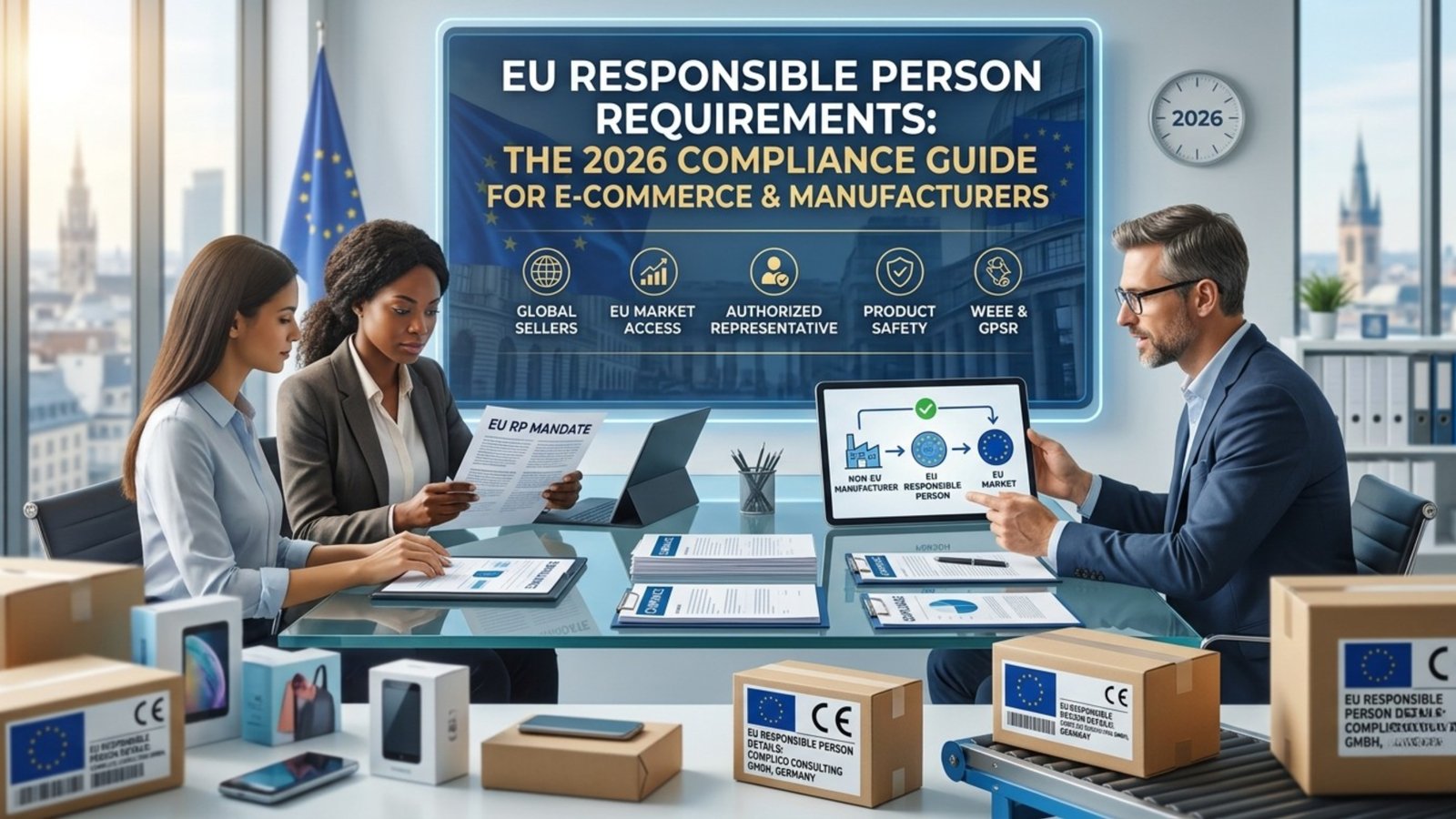
If you are selling products into the European Union from the outside, the regulatory landscape has officially shifted. With the full enforcement of the General Product Safety Regulation (GPSR) and the Market Surveillance Regulation (EU) 2019/1020, the days of cross-border e-commerce operating in a legal gray area are over.
Today, you cannot legally place a consumer product on the EU market without an established Responsible Person located within the European Union.
Whether you are an international manufacturer, a brand owner, or a seller utilizing platforms like Amazon FBA, eBay, Etsy, or TikTok Shop, failing to meet this requirement carries immediate consequences—from border seizures to permanent marketplace suspensions.
This comprehensive guide breaks down the exact EU Responsible Person requirements in 2026, what duties they perform, and how you can safeguard your business and keep your listings active.
What is an EU Responsible Person ?
An EU Responsible Person is a designated economic operator established within the European Union who takes legal accountability for a product's compliance and safety. They act as the official bridge between a non-EU brand and the European market surveillance authorities.
Introduced initially by the Market Surveillance Regulation and vastly expanded by the General Product Safety Regulation (GPSR) which took full effect in December 2024, this role ensures that if a product is deemed unsafe or non-compliant, there is a tangible entity within the EU jurisdiction to hold accountable.
This entity can be:
- An EU-based manufacturer.
- An EU-based importer.
- An Authorized Representative with a written mandate.
- A fulfillment service provider (only if none of the above exist).
For non-EU businesses, appointing an Authorized Representative to act as the Responsible Person is generally the most practical and secure route to market access.
Who Needs to Appoint a Responsible Person ?
The mandate is remarkably broad. It applies to all non-food consumer products sold to EU buyers, whether online or offline, B2C or B2B (if the product eventually reaches consumers). You must appoint a Responsible Person if you fall into any of these categories:
- Non-EU Manufacturers: If you produce goods outside the EU (e.g., in the UK, US, or Asia) and sell them directly to European consumers.
- Cross-Border E-Commerce Sellers: If you sell via your own Shopify store or marketplaces like Amazon, eBay, or TikTok Shop to EU buyers, you are responsible for ensuring the product has an EU point of contact.
- Brand Owners: If you source white-label products from overseas and sell them under your own brand name into the EU.
Note: If you are an EU-based manufacturer or you sell exclusively to an EU-based importer who assumes full legal responsibility, you may not need to appoint a separate third-party representative, as those entities fulfill the role by default.
Importer vs. Authorized Representative vs. Responsible Person
The terminology can be confusing. Here is how the roles differ and overlap under current EU law:
| Role | Definition | Can Act as the Responsible Person ? |
|---|---|---|
| EU Importer | An EU entity that physically brings goods from a third country into the EU market. They take on heavy compliance liabilities. | Yes, by default. |
| Authorized Representative | An EU entity appointed in writing by a non-EU manufacturer to carry out specific compliance tasks on their behalf. | Yes, if appointed via a written mandate. |
| Fulfillment Service Provider | A company (like Amazon FBA) offering warehousing, packaging, and dispatching services. | Yes, but only as a last resort if no other entity exists. Most refuse this liability. |
Think of it this way: Every Authorized Representative is a Responsible Person, but an EU Importer can be the Responsible Person without being formally called an Authorized Representative.
The Core Duties of an EU Responsible Person
A Responsible Person is not just a mailbox or a name on a label. Under Article 16 of the GPSR, they bear active, legally binding duties:
1. Verifying Technical Documentation
Before a product enters the market, the Responsible Person must verify that the manufacturer has drawn up the correct technical documentation. This includes checking risk assessments, product safety reports, and ensuring that instructions and safety information are available in the correct languages for the target Member States.
2. Market Surveillance Liaison
They serve as the single point of contact for market surveillance authorities. If a national market surveillance authority in Germany or France flags a safety concern, they will contact the Responsible Person. The representative must then provide all necessary documentation (like the Declaration of Conformity or test reports) within a strict timeframe.
3. Labeling and Traceability Checks
The Responsible Person must ensure the product bears the correct traceability information, such as batch codes, serial numbers, and the manufacturer's details. Furthermore, the Responsible Person's own name, postal address, and electronic address (email) must appear on the product, its packaging, or an accompanying document.
4. Incident Reporting and Corrective Actions
If a product presents a risk, the Responsible Person is required to immediately inform the market surveillance authorities and cooperate on corrective actions, which may include managing a product recall through the EU's Safety Gate system.
Category-Specific Challenges
Compliance is not a one-size-fits-all process. The required technical documentation heavily depends on the product category. When appointing a Responsible Person, they must verify specific directives:
- Toys: Must comply with the Toy Safety Directive, requiring strict chemical testing, mechanical safety assessments, and proper CE marking.
- Electronics: Must meet the Low Voltage Directive (LVD), Electromagnetic Compatibility (EMC), RoHS (restriction of hazardous substances), and often require WEEE registration.
- Cosmetics: Require registration in the Cosmetic Products Notification Portal (CPNP) and a dedicated Responsible Person specifically for cosmetics under Regulation (EC) No 1223/2009.
- Furniture & Household Items: While some may not require CE marking, they fall squarely under the GPSR and require a thorough internal risk analysis and clear safety instructions.
- Chemical Products: Require detailed Safety Data Sheets (SDS) and compliance with REACH and CLP regulations.
How to Display Responsible Person Details
Marketplaces and customs officials are actively checking for this information. The GPSR mandates that the contact details of the Responsible Person must be visible to the consumer before purchase and upon delivery.
Physical Products: The name, postal address, and email address of the Responsible Person must be printed on:
- The product itself (preferred).
- The product packaging (if the product is too small or its nature makes printing impossible).
- An accompanying document or parcel.
Digital Listings: Online marketplaces face massive fines if they host non-compliant products. Platforms like Amazon and Etsy now require you to upload the Responsible Person details directly into the back-end of your listing. This information is then displayed publicly on the product detail page. If this field is left blank, the listing is automatically suspended.
The Cost of Non-Compliance in 2026
The enforcement mechanisms introduced by the Market Surveillance Regulation and GPSR have equipped authorities with significant power. Failing to appoint a Responsible Person results in:
- Customs Seizures: Goods arriving at EU borders without the correct labeling will be held, returned, or destroyed at the shipper's expense.
- Marketplace Suspensions: Amazon, eBay, and others use automated systems to detect missing compliance data. Listings are suppressed immediately, cutting off your revenue stream.
- Fines and Market Bans: Continued attempts to sell non-compliant goods can result in severe financial penalties and permanent bans from selling within the European Economic Area.
Navigating EU Compliance with Complico Consulting GmbH
The regulatory burden on non-EU sellers is higher than ever, but it shouldn't be a barrier to growing your business in one of the world's largest consumer markets.
At Complico Consulting GmbH, based in Germany, we specialize in comprehensive European regulatory compliance. We act as your dedicated Responsible Person, bridging the gap between your international operations and EU requirements. Whether you are dealing with complex technical files for electronics, managing EPR (Extended Producer Responsibility) categories across multiple countries, or optimizing your Amazon FBA supply chain, we handle the regulatory heavy lifting so you can focus on sales.
Don't leave your market access to chance or risk listing suspensions. Ensure your products are fully compliant, properly documented, and legally represented in the EU.
Frequently Asked Questions (FAQs)
1. What is an EU Responsible Person ?
An EU Responsible Person is an economic operator established within the European Union who is legally responsible for ensuring that a product complies with applicable EU safety and compliance regulations. They act as the official contact for market surveillance authorities.
2. Who needs to appoint an EU Responsible Person ?
Non-EU manufacturers, brand owners, importers, and cross-border e-commerce sellers who place consumer products on the EU market generally need to appoint an EU Responsible Person if they do not have an EU-based manufacturer or importer fulfilling that role.
3. Is an EU Responsible Person mandatory under the GPSR ?
Yes. Under the General Product Safety Regulation (GPSR) and the Market Surveillance Regulation (EU) 2019/1020, most consumer products sold in the European Union must have a designated economic operator, such as an EU Responsible Person, before they can be legally placed on the market.
4. What is the difference between an EU Responsible Person and an Authorized Representative ?
An Authorized Representative is appointed by a non-EU manufacturer to perform specific compliance tasks. When authorized through a written mandate, they can also serve as the EU Responsible Person. However, an EU importer may automatically become the Responsible Person without being an Authorized Representative.
5. What are the main responsibilities of an EU Responsible Person ?
An EU Responsible Person verifies technical documentation, communicates with EU market surveillance authorities, checks product labeling and traceability, maintains compliance records, and assists with product recalls or corrective actions when necessary.
6. Where should the EU Responsible Person's details be displayed ?
The Responsible Person's name, postal address, and email address should appear on the product, its packaging, or an accompanying document where applicable. Many online marketplaces, including Amazon and Etsy, also require these details to be displayed on product listings.
7. What happens if I sell products in the EU without an EU Responsible Person ?
Failure to appoint an EU Responsible Person may result in customs delays or seizures, marketplace listing suspensions, product recalls, financial penalties, and restrictions on selling products within the European Union.
8. Do Amazon FBA, Shopify, Etsy, and eBay sellers need an EU Responsible Person ?
Yes. If you sell consumer products to customers in the European Union through Amazon FBA, Shopify, Etsy, eBay, TikTok Shop, or similar platforms from outside the EU, you may be required to appoint an EU Responsible Person to meet regulatory requirements.
9. Which products require an EU Responsible Person ?
Most non-food consumer products sold in the EU require an EU Responsible Person. This includes electronics, toys, household products, furniture, cosmetics, and many other product categories subject to EU safety legislation.
10. How can Complico Consulting GmbH help with EU Responsible Person services ?
Complico Consulting GmbH provides professional EU Responsible Person services for international manufacturers and e-commerce sellers. The company assists with technical documentation reviews, regulatory compliance, product labeling, communication with EU authorities, GPSR compliance, EPR guidance, and ongoing support to help businesses maintain uninterrupted access to the European market.