
If your business operates across European borders, you already know that data privacy is no longer just a box for the IT department to check it is a core pillar of corporate governance. For years, the European Union’s General Data Protection Regulation (GDPR) has been the undisputed heavyweight champion of privacy laws.
But when Switzerland’s fully revised Federal Act on Data Protection (FADP) entered into force in September 2023, it changed the game for any company targeting the Swiss market. Now, as we navigate through 2026, the initial scramble to update privacy policies is over. Instead, we are seeing the actual enforcement trends, regulatory priorities, and technological shifts that are actively shaping how companies must manage data.
At Complico Consulting GmbH, we help businesses bridge the gap between EU and Swiss privacy frameworks. If you are treating the Swiss FADP as simply "GDPR-lite," you are exposing your leadership team to significant risks. Let’s dive into the core differences and the major compliance trends defining 2026. You can read more about this in our comprehensive guide on Swiss FADP vs GDPR 2026.
1. FADP vs GDPR: The Fundamental Differences Refreshed
Before we look at the new trends, it is crucial to understand that while the FADP was designed to ensure seamless data flows with the EU by maintaining compatibility with the GDPR, the two laws are not identical. You can also review how other nations manage this by looking at our tool to compare privacy laws across different European regions.
They share the same DNA protecting the personal data of natural persons, enforcing transparency, and demanding strong security protocols but their operational mechanics diverge in ways that directly impact your daily operations.
The Opt-In vs. Opt-Out Divide
Under the GDPR, you need a strict lawful basis (such as explicit consent or a documented legitimate interest) for almost any data processing. It is fundamentally an "opt-in" regime.
The Swiss FADP, however, generally follows an "opt-out" philosophy for private companies. You do not necessarily need explicit consent to process non-sensitive personal data, provided you are transparent about it, the processing aligns with what the user would reasonably expect, and the user hasn't explicitly objected.
However, you absolutely must secure explicit opt-in consent under the FADP for:
- Processing highly sensitive personal data (which, in Switzerland, includes administrative or criminal proceedings, unlike the EU).
- High-risk profiling.
- Transferring data to countries without adequate data protection.
Quick Reference: FADP vs GDPR in 2026
| Feature | EU GDPR | Swiss FADP |
|---|---|---|
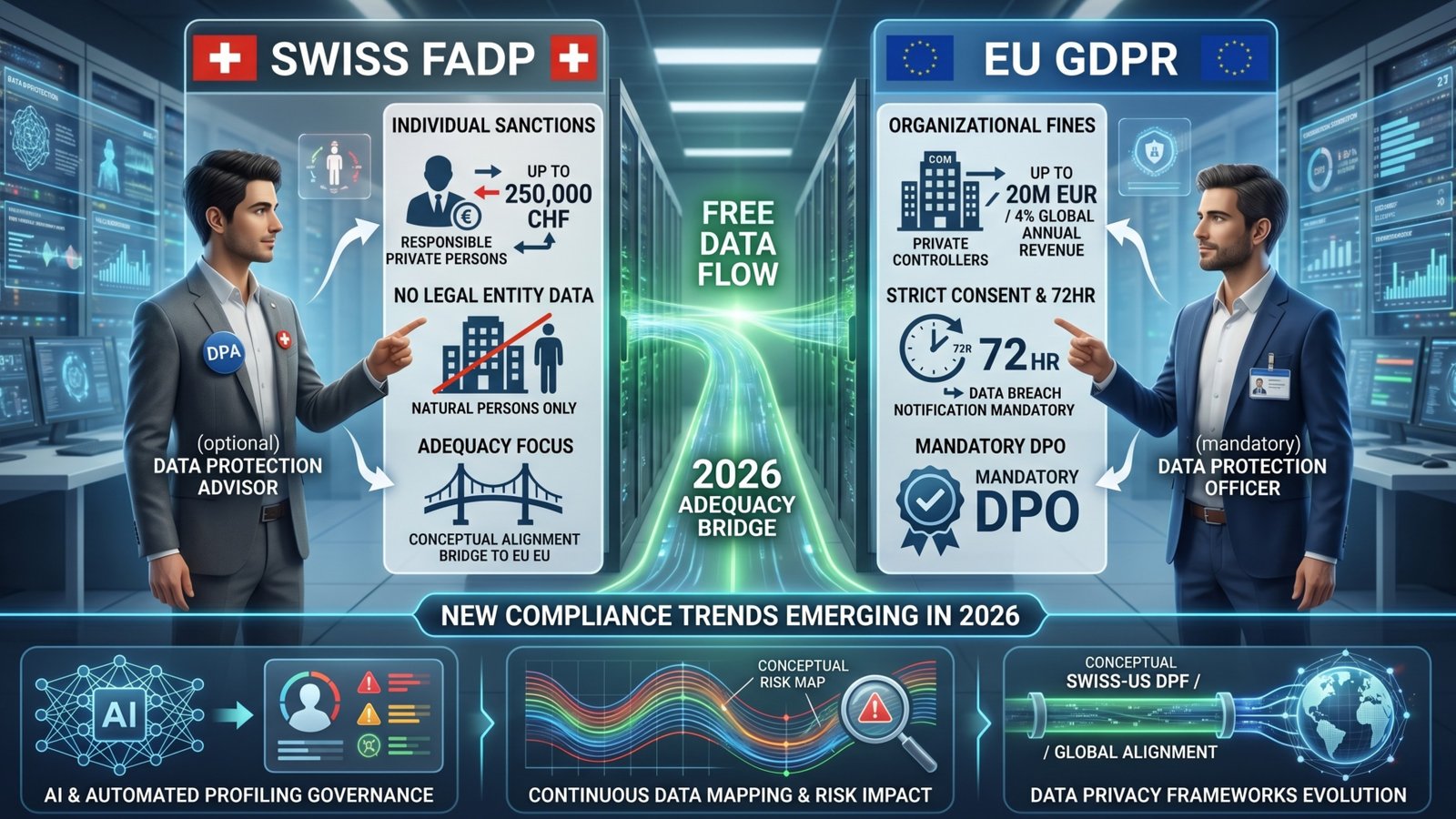
| Primary Penalty Target | The Corporation | The Individual (Management/Directors) |
| Maximum Fines | Up to €20M or 4% of global turnover | Up to CHF 250,000 |
| Lawful Basis | Required for all processing (e.g., consent) | Generally opt-out; consent needed for high-risk |
| Breach Notification | Within 72 hours of awareness | "As soon as possible" |
| Data Protection Officer | Mandatory in many high-risk cases | Optional (but highly recommended for alignment) |
| Age of Consent | Varies by member state (typically 13-16) | Not explicitly defined; relies on general civil law |
2. Trend 1: C-Suite Anxiety Over Personal Criminal Liability
Perhaps the most defining trend of 2026 regarding the Swiss FADP is how it has fundamentally altered board-level conversations.
If a company violates the GDPR, the regulatory hammer falls on the corporate entity. Massive fines make headlines, but they are ultimately paid out of the company treasury. For an overview of how severe these corporate penalties can get, you can look at the historical data on the biggest GDPR fines Europe has witnessed.
The Swiss FADP takes a sharper, more personal approach. Fines under the FADP max out at CHF 250,000—which seems like a slap on the wrist compared to the GDPR's €20 million maximum. However, the FADP targets the individual responsible for the violation, not the company. This means managing directors, C-suite executives, and senior compliance officers face personal criminal liability.
In 2026, we are seeing a massive trend of Swiss leadership teams demanding granular, independent audits of their data supply chains. Executives are no longer willing to sign off on generic data protection impact assessments (DPIAs) without hard proof that their systems are secure, because it is their personal bank accounts and criminal records on the line.
3. Trend 2: The AI Compliance Split
Artificial Intelligence has moved from a buzzword to standard operational infrastructure. As of April 2026, the EU AI Act is officially in force, creating a complex, risk-tiered regulatory matrix for any AI system operating in the EU. When combined with the GDPR's strict rules on automated decision-making, EU companies face a heavy, highly prescriptive compliance burden.
Switzerland has taken a different path. As of 2026, Switzerland has opted against a standalone, heavy-handed "Swiss AI Act." Instead, the Federal Data Protection and Information Commissioner (FDPIC) regulates AI through the principle-based framework of the FADP.
What this means for you:
- If you deploy AI tools (like predictive analytics, automated HR screening, or personalized marketing engines) across both regions, your compliance tracks are splitting.
- For the EU: You must comply with both the GDPR (Art. 22 on automated processing) AND the rigorous documentation, transparency, and risk-classification requirements of the new EU AI Act.
- For Switzerland: You must focus heavily on the FADP’s strict rules around "high-risk profiling." If your AI system matches data to assess essential aspects of a person's personality, health, or economic situation, the FADP requires explicit consent and a specialized Data Protection Impact Assessment (DPIA).
The trend for 2026 is building unified data inventories. Smart companies are mapping their AI data flows once, but applying two sets of operational tags: one for EU AI Act/GDPR compliance, and one tailored to the FADP's high-risk profiling standards.
4. Trend 3: Cross-Border Transfers and the Proxy Approach
Data rarely stays in one country. In 2024, the Swiss-US Data Privacy Framework (DPF) became effective, mirroring the EU-US DPF. This brought massive relief to companies relying on US-based SaaS tools (like CRMs, marketing automation, and cloud hosting), allowing free data flows to certified US vendors.
However, moving into 2026, regulatory scrutiny on cross-border transfers is intensifying. The FDPIC has made it clear that simply relying on standard contractual clauses (SCCs) without actual technical safeguards is a fast track to regulatory action.
A major emerging trend is the use of server-side tracking and data pseudonymization proxies. Rather than firing user data directly from a Swiss or EU citizen's browser to a US-based analytics server, companies are routing data through a European-hosted server first.
- The user data hits the EU/Swiss proxy.
- Direct identifiers (like IP addresses) are stripped or pseudonymized.
- The clean, non-identifiable data is forwarded to the US vendor.
This approach perfectly satisfies the GDPR's strict Schrems II requirements and the FADP’s cross-border transfer rules, allowing marketing teams to keep their tech stacks while keeping the legal teams out of trouble.
5. Trend 4: Hyper-Focus on Cookie and Tracking Transparency
While the GDPR and the ePrivacy Directive made the "cookie banner" a ubiquitous (and often annoying) part of the European internet experience, the FADP's stance was initially softer due to its opt-out nature.
However, recent 2025 and 2026 guidelines from the Swiss FDPIC have tightened the leash. While a traditional EU-style cookie banner isn't strictly required for basic analytics under Swiss law, the moment you use cookies for profiling, automated marketing, or sharing data with third parties, the FADP requires clear, upfront information and an easy way to opt out. To see how this overlaps with EU protocols, you can consult our corporate cookie policy framework.
If you use advanced tracking pixels, the FADP expects you to treat it with the same transparency as the GDPR. We are seeing a trend where companies are abandoning the "split-banner" approach (showing one banner to EU visitors and a different one to Swiss visitors) in favor of a unified, high-privacy standard that requires clear, informed consent across the board. It simplifies the user experience and drastically reduces compliance overhead.
6. Your 2026 Dual-Compliance Action Plan
If your company operates in both Switzerland and the EU, treating the two regulations as isolated silos is an expensive mistake. Here is how leading organizations are achieving streamlined dual compliance in 2026:
- Unify Your Record of Processing Activities (RoPA): You need a RoPA under both the GDPR and the FADP. Build a single, comprehensive register. Note the lawful basis for your EU subjects, and flag any "high-risk profiling" to satisfy Swiss requirements. Learn more about maintaining this document via our detailed breakdown on ROPA GDPR explained 2026.
- Upgrade Your DPIAs: When rolling out new software or AI tools, use the standard European Data Protection Board (EDPB) template for your impact assessments, but ensure you append a specific section addressing the Swiss definitions of sensitive data and profiling. If your duties also expand to corporate representation, you might want to look into the requirements of a GDPR Article 27 Representative.
- Audit Your Vendors: Review all third-party processors. Ensure that any data flowing from Switzerland to the US is covered by the Swiss-US DPF, and that your EU data flows are covered by the EU-US DPF. If a vendor isn't certified, you must implement updated SCCs and run a Transfer Impact Assessment. For broader enterprise operations, ensuring adherence to the terms of service becomes highly vital.
- Protect the C-Suite: Because of the FADP's personal liability clauses, ensure that your compliance protocols are documented, actively enforced, and signed off by legal. Ignorance is not a valid defense against a CHF 250,000 personal fine. If you run a cross-border entity, establishing structured setup documentation policy standards is standard best practice.
- Implement Privacy by Design: Stop bolting privacy on at the end of a project. Both the GDPR and the FADP legally mandate "Privacy by Design" and "Privacy by Default." Ensure your development and marketing teams are trained to collect only the data they strictly need. Be sure to anchor these steps within your public privacy policy pages.
Let Complico Consulting GmbH Secure Your Future
Navigating the nuances between the GDPR and the Swiss FADP in 2026 requires more than just downloading a legal template from the internet. It requires a strategic alignment of your technology, your marketing goals, and your corporate governance. You can read more about us and our methodologies online.
The regulatory landscape is tightening, and the cost of getting it wrong both financially and personally has never been higher. Explore our competitive options on our pricing page or look through our professional corporate services.
At Complico Consulting GmbH, we specialize in cutting through the legal noise. We provide actionable, pragmatic compliance frameworks that protect your business, secure your leadership team from personal liability, and build trust with your customers. If your business expands into product compliance, we also cover solutions such as acting as an EU Authorised Representative.
Don't wait for a regulatory audit to find the gaps in your data strategy. Contact us today to schedule a comprehensive 2026 privacy health check for your organization. Let us handle the compliance, so you can focus on growth.