
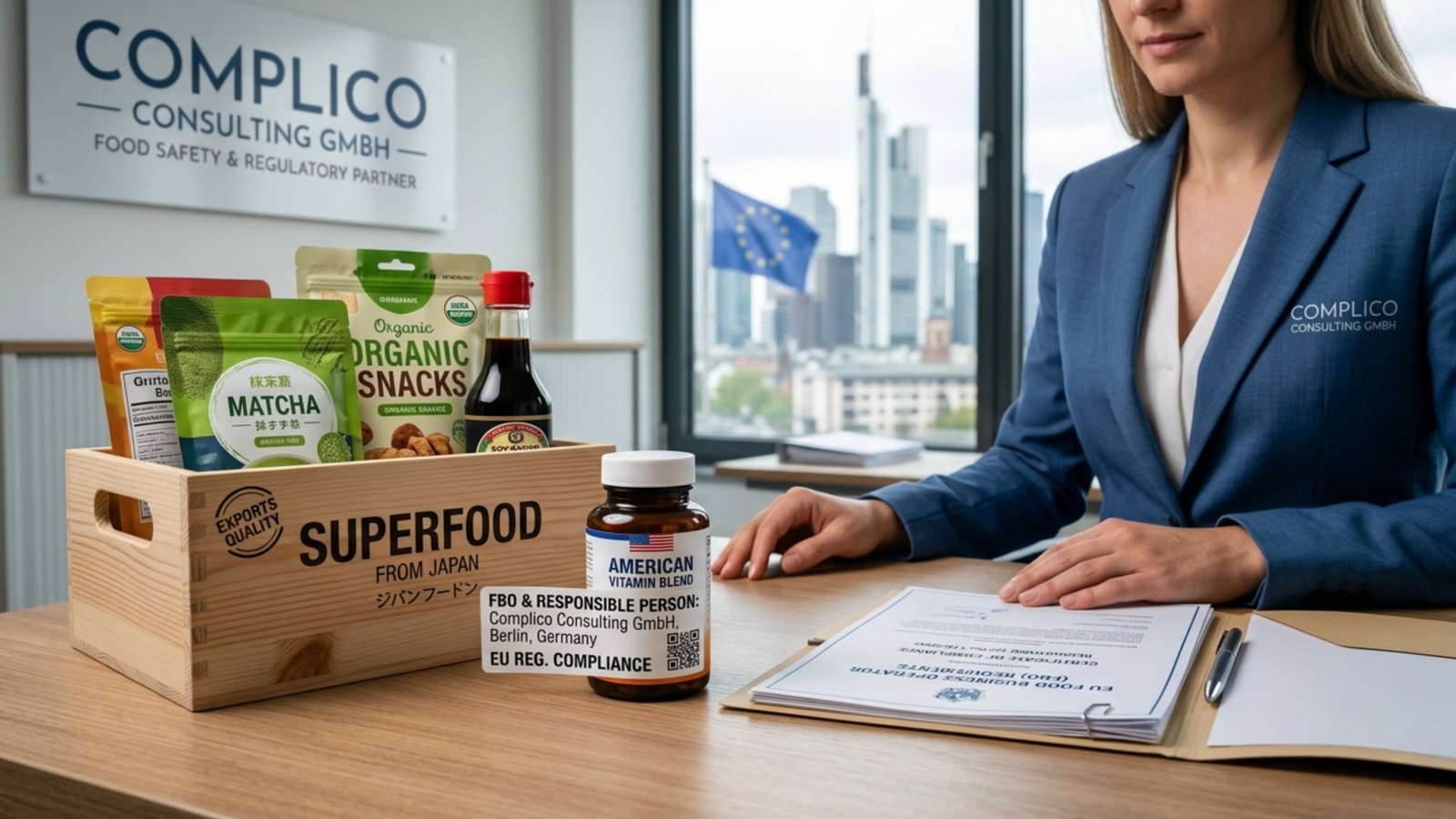
The European food market is undergoing a silent structural shift. For years, international food, beverage, and dietary supplement brands viewed the European Union as a fragmented but highly lucrative goldmine. The playbook seemed straightforward: formulate a stellar product, translate the packaging into the local language, list it on an e-commerce platform or find a regional distributor, and watch the orders roll in.
That old playbook is officially obsolete.
As global supply chains face heightened safety, sustainability, and transparency demands, European enforcement agencies are cracking down on a critical structural gap: the lack of a legally responsible entity physically located inside the European Union borders. This realization has thrust Food Business Operator compliance directly into the international spotlight. Whether you are an organic snack brand from Chicago, a tea exporter from Kyoto, or a functional beverage startup from London, understanding this requirement is no longer an optional regulatory hurdle it is the baseline requirement for market access.
What is a Food Business Operator (FBO) ?
To understand why European market entry has become more complex, we must look at the foundational architecture of EU food safety law. Under Regulation (EC) No 178/2002 (commonly known as the General Food Law), Europe established a strict, unbroken chain of physical traceability. The fundamental principle is that every single food product consumed within the EU must be traceable back to an entity that can be held legally accountable if a public health crisis occurs.
An EU-defined Food Business Operator is the natural or legal person responsible for ensuring that the requirements of food law are met within the food business under their control.
This means that if a product is found to contain an undeclared allergen, unauthorized pesticide residue, or incorrect nutritional labeling, regional authorities do not send an email to an overseas office. They require an established, physical presence within their jurisdiction to handle immediate product withdrawals, address consumer safety, and face legal liability.
The Traceability Axiom: EU food law relies on a strict "one-step-forward, one-step-back" traceability system. Every operator must be able to prove exactly who supplied their ingredients and exactly which business they supplied their finished goods to. If you are outside the EU, you sit entirely outside this tracking loop unless you have an anchored representative inside the single market.
The Article 8 Trap: The Responsibility Gap for Non-EU Brands
For brands physically operating inside the EU, the identity of the responsible party is obvious: it is the local manufacturer, processor, or primary packer. However, for an international brand operating outside European borders, a massive compliance vulnerability emerges. The EU cannot easily exercise regulatory or criminal jurisdiction over an executive team sitting in North America, Asia, or the UK.
To solve this, Regulation (EU) No 1169/2011 on the provision of Food Information to Consumers (FIC) introduced a clear hierarchy under Article 8.
The regulation states that the entity responsible for the compliance of food information is the operator under whose name or business name the product is marketed. Crucially, if that operator is not established within the European Union, the legal responsibility automatically defaults to the importer into the EU market.
If your business relies on a traditional distribution model where a European distributor purchases your inventory container-by-container, that distributor technically acts as the importer and assumes the legal FBO mantle for those specific batches. But if you sell through modern decentralized fulfillment structures such as Amazon FBA, eBay, Etsy, or direct-to-consumer localized e-commerce stores the traditional importer disappears.
Without a clearly designated, legally contracted Food Business Operator established inside the EU to act as your regulatory anchor, your products are legally non-compliant. They are exposed to immediate customs seizures, marketplace listing deletions, and severe financial penalties.
The Physical Packaging Mandate: No Digital Shortcuts
A common misconception among cross-border brands is that digital info shortcuts satisfy consumer safety laws. Many brands assume that adding a QR code, an email address, or a corporate website URL to the product packaging fulfills the contact requirement.
European food enforcement agencies strictly reject this approach.
The law dictates that the physical label on the food product must permanently display the complete name and physical postal address of the responsible Food Business Operator established within the EU. This address must be detailed enough to allow a consumer or a regional food safety inspector (such as Germany's BVL or France's DGCCRF) to send a physical, registered legal letter to the location. It cannot be a temporary mailbox, a virtual dead-drop, or a standard PO Box without an actual corporate presence operating behind it.
When optimizing your packaging space for European distribution, look closely at how the layout accommodates this mandatory address text. It must be legible, indelible, and grouped alongside your standard ingredient declarations and nutritional panels.
Strategic Comparison: How Does Your FBO Model Match Your Risk Profile ?
Before moving your inventory across European borders, you need to decide which operational structure will support your compliance framework. Relying on an ad-hoc importer or opting for an independent, professional compliance representative completely changes your control over the market.
| Compliance Variable | The Commercial Importer Model | The Authorized FBO Representative Model |
|---|---|---|
| Legal Anchor | Your wholesale distributor or regional retail buyer. | A contracted, independent compliance specialist (e.g., Complico Consulting). |
| IP & Brand Control | Low. Your compliance is bound to a commercial partner who controls your market access. | High. You separate your compliance anchor from your commercial sales channels. |
| Multi-Channel Flexibility | Restricted. A single distributor cannot easily act as the FBO for your sales on alternate platforms. | Omnichannel. One centralized FBO address covers Amazon FBA, direct e-commerce, and retail. |
| Audit & Recall Readiness | Variable. Distributors focus on sales volume, not maintaining complex regulatory technical files. | Dedicated. Continuous monitoring of product formulation, allergens, and local enforcement updates. |
Step-by-Step Pathway to Establishing a Compliant European Food Infrastructure
Transitioning from an unverified importer structure to a fully compliant framework requires an organized, systematic review of your formulations, labels, and contracts. Here is how international brands construct a secure compliance framework when entering the European market:
1. Formulation and Additive Audit:
Phase 1: Compliance Foundations.
Before assigning an FBO address, verify that every ingredient, additive, colorant, and maximum vitamin dosage is explicitly authorized under EU Regulation (EC) No 1333/2008. Additives common in other jurisdictions (such as titanium dioxide or certain artificial colorants requiring warning labels) can cause immediate shipment rejections.
2. Designate Your EU Legal Anchor:
Phase 2: Entity Selection.
Establish a corporate partnership with a professional entity physically located within the EU. If you sell via direct-to-consumer e-commerce or multiple independent retailers, contract an independent compliance firm to act as your authorized Food Business Operator to maintain logistical flexibility across all channels.
3. Execute Packaging and Label Adaptation:
Phase 3: Label Overhaul.
Re-engineer your product labels to display the mandatory European food information in the official languages of your target market. Ensure the legal name and physical postal address of your designated EU FBO are clearly printed on the outer packaging, alongside compliant nutritional values per 100g or 100ml.
4. Build and Maintain the Technical Compliance File:
Phase 4: Document Governance.
Provide your EU-based FBO with a complete technical dossier for each SKU. This file must contain your Hazard Analysis Critical Control Point (HACCP) certifications, allergen cross-contamination logs, shelf-life validation studies, and country-of-origin documentation, keeping everything audit-ready for local food inspectation teams.
Real-World Enforcement in 2026: The Risk of Getting It Wrong
The enforcement landscape across Europe has grown remarkably sophisticated. Regulatory authorities now utilize automated digital screening tools to monitor e-commerce listings, alongside random physical spot-checks at major entry ports like Hamburg, Rotterdam, and Antwerp.
If a product arrives at the border or is found in a fulfillment center without a valid, verifiable Food Business Operator name and address on the label, authorities initiate a standard, highly disruptive enforcement sequence:
- Immediate Customs Retention: Shipments are held at the border at the importer's expense, frequently triggering cascading storage fees.
- Systemic Rapid Alert Notifications: Non-compliant products are flagged on the EU's Rapid Alert System for Food and Feed (RASFF), alerting inspectors across all 27 member states to watch for your brand name.
- Marketplace Delisting: Digital platforms like Amazon FBA proactively suspend product listings when flagged by a European authority, freezing your digital storefront and your regional revenue stream.
- Mandatory Destruction or Re-Export: If compliance cannot be proven within a narrow window, you face the financial loss of forced inventory destruction or expensive re-export out of the single market.
Secure Your European Market Access with Complico Consulting
Navigating European food safety regulations doesn't have to stall your international growth. At Complico Consulting GmbH, we specialize in providing clear, legally sound compliance solutions tailored to global brands entering the European market.
Based in Germany, our team operates as your professional regulatory anchor, providing the mandatory physical EU footprint, managing your technical compliance documentation, and safeguarding your marketplace infrastructure across all distribution channels. Don't leave your European expansion exposed to sudden customs stops or listing suspensions. Contact us today to verify your product labels, secure your compliance framework, and establish a bulletproof market presence.