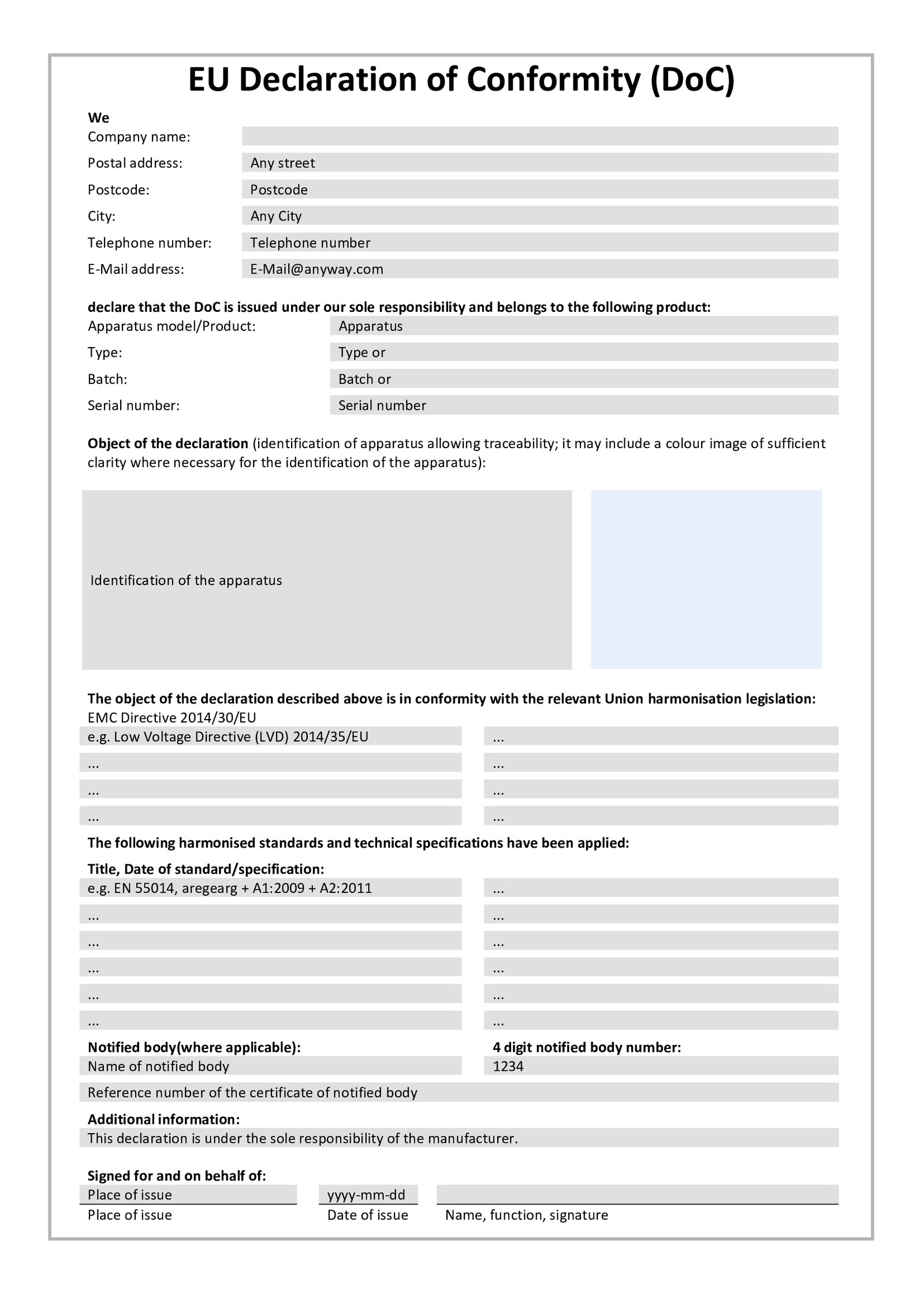
The DoC is a formal legal statement issued and signed by the manufacturer (or their Authorized Representative). It confirms that the product meets the essential requirements of all applicable EU directives and regulations.
By signing it, you are stating: "We have done the testing, we have the technical documentation to prove it, and we take full responsibility for this product's compliance."
EU rules require every declaration to contain specific, standardized elements. While the formatting can vary slightly, the content cannot. Here is the blueprint you need to follow:
You must be specific enough to ensure full traceability. This isn't just "Bluetooth Speaker."
Include: Product name/type designation, model number, and the serial or batch number.
This is the legal entity taking responsibility for the product.
Include: The full registered legal name and complete postal address.
If your manufacturing company is located outside of the EU or EEA, you generally need an EU Authorized Representative (AR) or Responsible Person.
Include: The AR's full legal name and physical address within the EU.
This is standard legal boilerplate that EU law requires verbatim.
Required text: "This declaration of conformity is issued under the sole responsibility of the manufacturer."
This is a short, unambiguous description of the product the declaration covers. It must clearly link back to the product identification in step one.
Pro Tip: Adding a color photograph of the product here is highly recommended for clarity, especially for consumer goods and toys. Learn more about EU product safety labeling requirements.
You must list every single EU Directive or Regulation that applies to your product.
Include: The official directive numbers (e.g., Directive 2014/30/EU for Electromagnetic Compatibility or Directive 2011/65/EU for RoHS). Ensure you are citing the current, active versions. If you sell general consumer products, review our GPSR compliance services to make sure you're covering every applicable regulation.
This is where you prove how you met the legislation listed in step six.
Include: The specific European Standards (EN standards) you tested against, including the standard number, publication year, and any amendments (e.g., EN 55032:2015). Do not list standards you haven't actually applied. Our guide to technical file documentation explains how to keep your standards references organized and audit-ready.
For higher-risk products (like medical devices or certain machinery), a third-party testing laboratory—known as a Notified Body—must be involved in the conformity assessment.
Include: The Notified Body's name, address, 4-digit identification number, and a reference to the certificate they issued. If you self-certified, you can omit this section or state "Not applicable."
The DoC must be signed by someone with the legal authority to bind the manufacturer.
Include: The place of issue (City, Country), date of issue, name, function/title of the signatory, and their signature.
Drafting it too early: Never sign a DoC before your technical file (test reports, risk assessments, manuals) is 100% complete. The date of the DoC must be after the conformity assessment is finished. Our GPSR risk assessment guide can help you complete this step correctly the first time.
Using outdated standards: The EU frequently updates its harmonized standards via the NANDO database. Citing a withdrawn standard automatically invalidates your DoC.
Language barriers: You must translate the DoC into the language or languages required by the specific EU Member States where your product is sold. If you're launching across multiple markets, our EU product compliance laws overview breaks down country-specific requirements.
Your EU Declaration of Conformity is a living document. If you change the product's design, update the software in a way that affects compliance, or if the EU updates the applicable directives, you must issue a new DoC.
Keep a signed copy of your DoC (along with your technical file) for at least 10 years after the last unit of that product model is placed on the market. Authorities can ask for it at any time, and your ability to produce a flawless document immediately is your best defense against market surveillance issues.
Need help preparing a compliant Declaration of Conformity, technical file, or CE marking strategy ? Our team can also assist with EPREL registration, GDPR Article 27 representation, Extended Producer Responsibility (EPR), and Safety Data Sheet (SDS) services. Check out our full range of compliance services or contact us to get started, and see our pricing for a transparent breakdown of costs. You can also browse more insights on our blog.