
Summarize this article with:
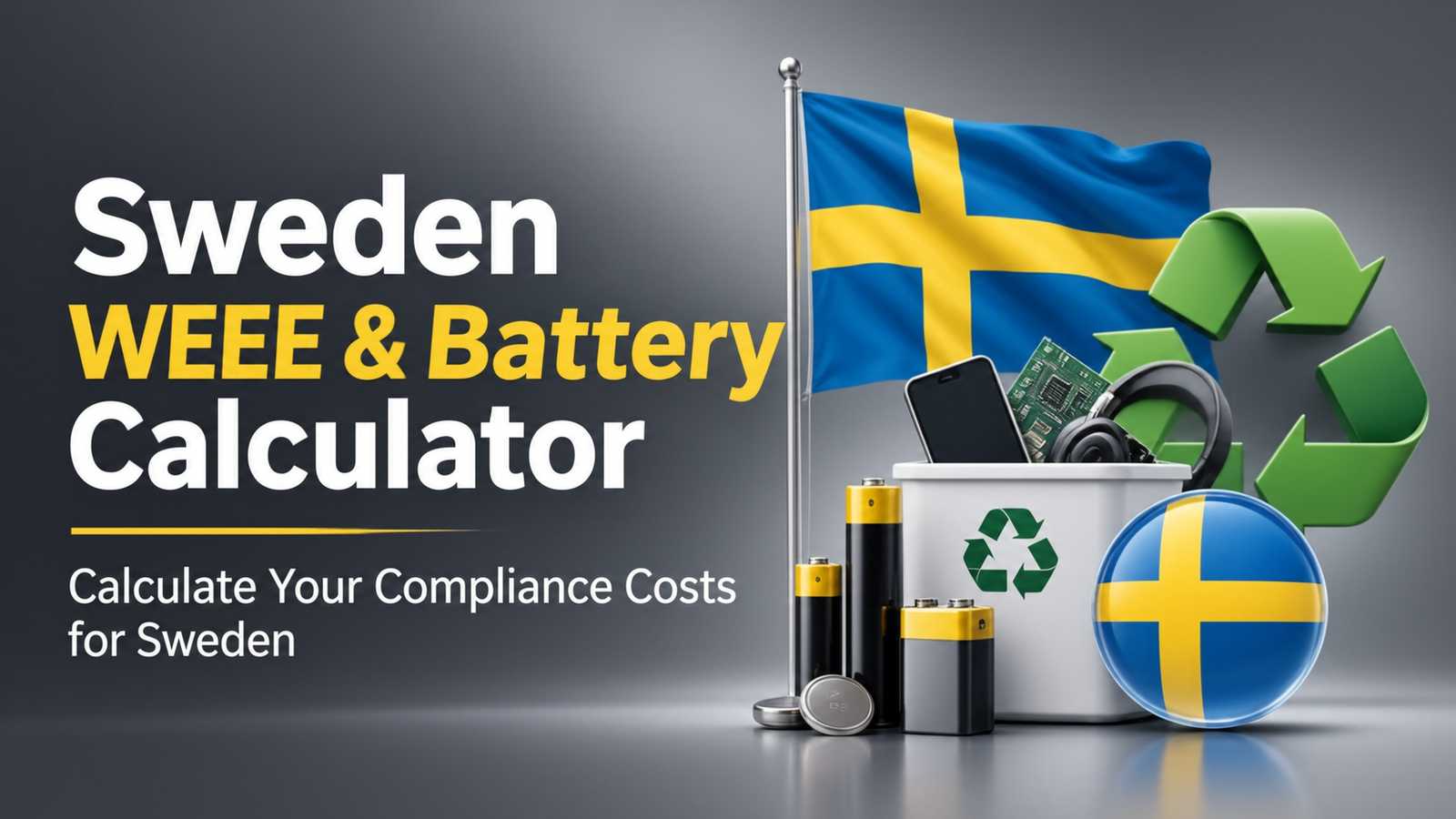
Sweden WEEE & Battery Calculator: Estimate Your Swedish EPR Fees in Minutes
Selling electronics, smart devices, or battery-powered goods into the Nordic market opens up one of Europe’s most digitally advanced consumer bases. Yet anyone who has shipped goods across the Öresund Bridge knows that Swedish environmental law leaves zero room for guesswork. Before a single parcel reaches a customer in Stockholm, Gothenburg, or Malmö, businesses must register with Naturvårdsverket (the Swedish Environmental Protection Agency), appoint a local Authorized Representative if selling cross-border without a Swedish entity, join an approved Producer Responsibility Organization (PRO), and budget accurately for annual recycling contributions.
Calculating those fees manually—especially when a single SKU triggers both electronics and battery obligations—is where most compliance budgets fall apart. That is why Complico Consulting GmbH built a dedicated WEEE & Battery calculator tailored specifically to Sweden’s regulatory framework. Whether you are launching your first cross-border e-commerce store or scaling a multi-brand hardware catalog, knowing your exact Extended Producer Responsibility (EPR) liability upfront protects your profit margins and keeps your marketplace listings active.
Why Swedish WEEE and Battery Compliance Demands Upfront Cost Clarity
Sweden enforces Extended Producer Responsibility under the strict "polluter pays" principle. Under Swedish Ordinance (2022:1276) on Producer Responsibility for Electrical and Electronic Equipment and the EU Batteries Regulation (Regulation (EU) 2023/1542), any company placing electrical and electronic equipment (EEE) or batteries onto the Swedish market for the first time is legally classified as a "producer."
Unlike markets where flat administrative fees dominate, Swedish EPR costs depend heavily on granular product data:
- Dual-Stream Overlap: A wireless speaker, smart watch, or cordless power tool sold in Sweden is not treated as a single compliance item. The device housing and circuit board fall under WEEE, while the internal lithium-ion cell falls separately under Battery EPR.
- Weight and Chemistry Tiers: Swedish Producer Responsibility Organizations calculate variable recycling fees based on net equipment weight, unit counts, battery chemistry (such as lithium-ion, alkaline, or nickel-metal hydride), and whether the product is intended for private households (B2C) or professional commercial users (B2B).
- Supervisory and Administrative Levies: Beyond PRO recycling tariffs, producers face annual regulatory supervision fees payable to Naturvårdsverket, alongside local Authorized Representative retainer fees for foreign distance sellers.
Using a reliable WEEE & Battery calculator before setting retail prices ensures you never absorb unexpected environmental levies out of your net margin after the fiscal year closes.
Understanding the Two Pillars of Swedish Electronics and Battery Law
To get accurate results out of any compliance estimator, it helps to understand how Swedish authorities divide electrical hardware and energy storage devices.
1. Waste Electrical and Electronic Equipment (WEEE) in Sweden
Sweden transposes the EU WEEE Directive through Ordinance (2022:1276). Registration in Naturvårdsverket’s national EEB register is mandatory before placing any covered equipment on the market—there is no minimum sales threshold or small-seller exemption. Our guide to Swedish WEEE registration explains the process in detail.
Swedish law groups electrical equipment into six primary categories:
| Swedish WEEE Category | Typical Products Covered | Household (B2C) PRO Requirement |
|---|---|---|
| 1. Temperature Exchange Equipment | Refrigerators, freezers, air conditioners, heat pumps, dehumidifiers | Mandatory approved PRO (e.g., El-Kretsen or Recipo) |
| 2. Screens and Monitors | Televisions, computer monitors, tablets, laptops, digital photo frames | Mandatory approved PRO |
| 3. Lamps | LED bulbs, fluorescent tubes, high-intensity discharge lamps | Mandatory approved PRO |
| 4. Large Equipment | Washing machines, electric stoves, large printers, photovoltaic panels, commercial servers (any dimension over 50 cm) | Mandatory approved PRO for household equipment |
| 5. Small Equipment | Vacuum cleaners, kitchen appliances, power tools, toys, smart home sensors, luminaires (all dimensions under 50 cm) | Mandatory approved PRO |
| 6. Small IT & Telecom Equipment | Smartphones, routers, GPS devices, pocket calculators, smartwatches (all dimensions under 50 cm) | Mandatory approved PRO |
For household EEE, producers must join an approved Swedish collection scheme such as El-Kretsen or Recipo. For strictly professional (B2B) equipment, collective scheme membership is not always mandatory, provided the producer establishes verifiable, compliant take-back and waste treatment arrangements.
2. Battery EPR Under the EU Batteries Regulation
With the EU Batteries Regulation (Regulation (EU) 2023/1542) fully operational across Member States, Swedish battery compliance has undergone major structural updates. Every producer placing standalone batteries or batteries incorporated inside appliances onto the Swedish market must register with Naturvårdsverket—receiving a Swedish battery EPR identifier formatted with the prefix SEBATT followed by six digits—and affiliate with an approved battery PRO or hold individual authorization. For wider context, see our overview of the EU Battery Regulation and EPR.
Under the harmonized EU framework, batteries are classified into five distinct regulatory categories:
- Portable Batteries: Sealed batteries weighing 5 kg or less that are not designed for industrial use (e.g., AA/AAA cells, smartphone batteries, laptop battery packs, cordless drill batteries).
- Light Means of Transport (LMT) Batteries: Sealed batteries weighing 25 kg or less designed to power wheeled vehicles such as e-bikes and e-scooters.
- Starting, Lighting, and Ignition (SLI) Batteries: Batteries used primarily for vehicle ignition, lighting, or auxiliary power.
- Industrial Batteries: Batteries designed specifically for industrial uses, stationary energy storage systems, or any battery exceeding 5 kg that does not fall under LMT, SLI, or EV categories.
- Electric Vehicle (EV) Batteries: Batteries designed to provide traction power to hybrid or fully electric road vehicles.
Because portable lithium-ion batteries carry significantly higher recycling and fire-safety handling costs than standard alkaline cells, chemistry-level separation is essential when forecasting annual fees.
How Complico Consulting GmbH’s Sweden WEEE & Battery Calculator Works
Many online spreadsheets rely on outdated flat-rate averages that either overestimate small e-commerce shipments or omit mandatory local representation and statutory agency charges. Complico Consulting GmbH designed its WEEE & Battery calculator around real Swedish compliance mechanics so finance teams, founders, and compliance managers can model realistic costs in three straightforward steps.
Step 1: Define Your Business Profile and Sales Channel
Start by indicating where your company is legally established and how you reach Swedish buyers. If your business does not maintain a registered branch in Sweden and sells directly to Swedish end users via your own webshop or online marketplaces (such as Amazon.se, CDON, or Fyndiq), Swedish law requires you to appoint a Swedish-established Authorized Representative. Notably, an Authorized Representative established in Germany or another EU country does not automatically satisfy Sweden’s local establishment requirement for distance sellers. Factoring this into the calculator immediately clarifies your fixed annual baseline.
Step 2: Input Your Product Categories, Weights, and Volumes
Next, enter your projected annual Swedish sales volumes segmented by:
- WEEE Equipment Category (Categories 1 through 6)
- Net Device Weight (excluding packaging and removable batteries)
- Battery Category & Chemistry (e.g., Portable Li-Ion, Portable Alkaline, LMT, or Industrial)
- Net Battery Weight and Unit Count
- End-User Split (B2C household vs. B2B professional)
If your products contain built-in batteries, separating the net weight of the battery from the net weight of the electronic device prevents double-paying weight tariffs while ensuring both statutory streams are covered.
Step 3: Review Your Itemized Swedish EPR Cost Breakdown
Once submitted, the WEEE & Battery calculator generates a transparent cost projection breaking down:
- Estimated annual PRO recycling and weight-based fees for WEEE
- Estimated annual PRO collection and treatment fees for Batteries
- Naturvårdsverket statutory registration and annual supervisory fees
- Local Swedish Authorized Representative service requirements (where applicable)
Armed with this breakdown, you can compare quarterly versus annual reporting scenarios, adjust per-unit landed cost calculations, and request direct onboarding support from Complico Consulting GmbH’s compliance specialists. You can also review our pricing for registration and representation services.
Key Deadlines and Compliance Milestones for Sweden
Budgeting accurately is only half the equation; missing a statutory filing window in Sweden triggers administrative sanction fees (miljösanktionsavgifter) and potential sales bans. Keep these core Swedish dates on your compliance calendar:
- Before First Market Placement: Registration with Naturvårdsverket and PRO affiliation must be active prior to shipping or offering your first product in Sweden.
- 31 March (Annual Statutory Reporting): Both WEEE and Battery producers must submit their annual market-placement reports covering the preceding calendar year to Naturvårdsverket by 31 March.
- Periodic PRO Declarations: Depending on your contract volume with El-Kretsen, Recipo, or an approved battery PRO, weight declarations are submitted monthly, quarterly, or annually.
- Marketplace Verification: Online marketplaces operating in Sweden actively verify seller EPR registration numbers and de-list non-compliant ASINs or merchant accounts until valid registration proof is uploaded.
Common Mistakes Businesses Make When Estimating Swedish EPR Costs
Even experienced European sellers run into avoidable compliance bottlenecks when entering Sweden. Watch out for these five frequent missteps:
- Assuming an EU Entity Exempts You from a Swedish Authorized Representative: Under Swedish WEEE and Battery rules, foreign distance sellers supplying Swedish end users directly must appoint an Authorized Representative physically established in Sweden. Having a GmbH in Germany or an SARL in France does not waive this obligation.
- Reporting Gross Shipping Weight Instead of Net Product Weight: Cardboard boxes, foam inserts, and user manuals belong under Swedish Packaging EPR (administered separately via schemes like Näringslivets Producentansvar). Including packaging weight in your WEEE or Battery declaration inflates your electronics fees unnecessarily.
- Forgetting Embedded Button Cells and Coin Batteries: Small items like key fobs, digital thermometers, greeting cards, or LED tealights often contain tiny lithium or silver-oxide coin cells. Even if a battery weighs 3 grams, it triggers full Battery EPR registration and reporting.
- Misclassifying B2C Products as B2B: Simply selling through a wholesale portal does not make a product "professional B2B equipment." If an item—such as a standard laptop, desk lamp, or smartphone charger—can reasonably be used in both private homes and offices, Swedish authorities classify it as dual-use household (B2C) equipment subject to mandatory household PRO membership.
- Overlooking the "De Minimis" Myth: Unlike certain tax thresholds, Sweden has zero minimum weight or revenue threshold for WEEE and Battery registration. Selling a single smart device to one Swedish consumer legally triggers producer responsibility.
Why Partner with Complico Consulting GmbH for Nordic and EU EPR ?
Navigating Swedish regulations alongside German (ElektroG, BattG, VerpackDG), French, Dutch, and Austrian compliance rules requires a unified operational partner rather than fragmented local middlemen. Complico Consulting GmbH combines automated digital tools—like our free WEEE & Battery calculator—with hands-on legal and regulatory execution across Europe. Explore our full range of compliance services.
When you work with Complico Consulting GmbH, you benefit from:
- End-to-End Registration Management: From preparing Naturvårdsverket filings to securing your official WEEE and SEBATT battery registration numbers (see our WEEE number guide for Europe).
- Vetted Local Authorized Representation: Seamless appointment of compliant Swedish-established Authorized Representatives for non-Swedish distance sellers.
- PRO Onboarding & Tariff Optimization: Direct coordination with approved Swedish recycling organizations to match your exact product mix to the lowest eligible fee tier.
- Multi-Country Portfolio Scaling: Centralized reporting workflows covering Sweden, Germany, Austria, the Netherlands, France, and wider EU jurisdictions under one roof. For a broader view, read our EPR Europe guide.
Ready to see what Swedish compliance will actually cost your business ? Run your numbers through Complico Consulting GmbH’s Sweden WEEE & Battery calculator today, or book a consultation with our regulatory team to get your Swedish EPR numbers secured before your next shipment crosses the border.
Frequently Asked Questions (FAQ)
1. How accurate is the Sweden WEEE & Battery calculator for estimating my annual compliance fees ?
Complico Consulting GmbH’s WEEE & Battery calculator uses current Swedish Producer Responsibility Organization (PRO) weight tariffs, battery chemistry classifications, and statutory Naturvårdsverket administrative fee structures to generate a realistic cost estimate. Because final PRO invoices depend on exact declared net weights and specific scheme contracts, the calculator gives you a reliable budgeting baseline before you commit to registration.
2. Do I need separate registrations in Sweden if my electronic product has a built-in battery ?
Yes. Under Swedish law, electrical equipment and batteries are governed by two distinct compliance streams. If you sell a device with an integrated or removable battery—such as a Bluetooth headset, smartwatch, or rechargeable vacuum—you must register as both a WEEE producer and a Battery producer with Naturvårdsverket, and report the net weight of the device separately from the net weight of the battery.
3. Is there a small-seller exemption or minimum sales threshold for WEEE and Battery EPR in Sweden ?
No. Sweden does not offer a de minimis threshold based on annual turnover, unit count, or total kilograms placed on the market. Whether you sell ten units or ten thousand units to Swedish customers, you are legally required to register with Naturvårdsverket and arrange compliant collection and recycling before making your first sale.
4. Does a foreign e-commerce seller need a Swedish Authorized Representative ?
Yes, if you sell directly to Swedish end users via distance contracts (such as your own online store or third-party marketplaces) and do not have a registered legal entity in Sweden. Swedish regulations require foreign distance sellers to appoint an Authorized Representative physically established in Sweden to fulfill statutory WEEE and Battery obligations on their behalf.
5. What happens if I sell electronics or batteries in Sweden without registering ?
Placing unregistered electronics or batteries on the Swedish market violates Swedish environmental ordinances and EU regulations. Naturvårdsverket can impose administrative environmental sanction fees, issue sales prohibitions, and require retroactive reporting and fee payments. Additionally, major online marketplaces actively suspend non-compliant product listings and freeze seller accounts until valid Swedish WEEE and SEBATT battery registration numbers are verified. More questions ? Visit our FAQ page.